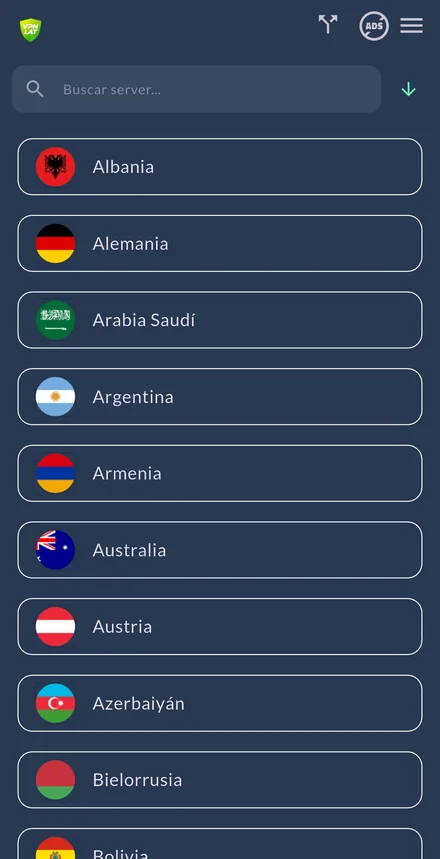
VPN.lat has free servers in the United States. No account, no email, no card, no data cap. You download the app, pick the US and you have an American IP.
This is the most requested server on our list, and the people asking for it want two different things. Some are outside the US and need an American IP. Others are in the US and want their internet provider to stop watching what they do — which, in the United States specifically, is a more reasonable concern than most people realise.
Get it on Android
Get it on iOS
Why your ISP is the reason most Americans install a VPN
Here's the part that gets left out of most VPN pages.
In 2017, Congress repealed the broadband privacy rules the FCC had adopted, which would have required internet providers to get your permission before selling your browsing data. The repeal means that in the US, your ISP is legally allowed to collect and monetise what sites you visit. That isn't a conspiracy theory or a sales pitch — it's the regulatory status quo.
With a VPN on, your provider sees one thing: an encrypted connection to a server. Not the sites, not the searches, not the apps. There's nothing itemised to sell.
That's the honest version of the privacy argument in the US, and it doesn't require exaggerating anything.
What it doesn't do, which fewer people will tell you
It doesn't make you anonymous once you log in. Open Gmail, Instagram or Amazon and those companies know exactly who you are. The IP changes; your account doesn't.
It doesn't stop ad tracking by itself. Cookies, browser fingerprinting and the identifiers in your phone keep working. A VPN hides the route, not your browser.
It doesn't make illegal things legal, and it doesn't protect you from downloading something malicious.
It isn't a shield against your employer. On a work laptop or a work network, the IT department usually has far more visibility than your ISP ever did.
Gaming: when a US server actually helps
In competitive games the only thing about your connection that decides matches is ping, not bandwidth. And ping only improves if the path between you and the game server gets shorter and cleaner.
Most North American game servers are in the US — Virginia, Chicago, Dallas, Los Angeles — so if you're already in the US with a clean route, adding a VPN adds a hop and ping goes up slightly. It's not an accelerator, and anyone selling it as one is lying.
Where a US server does help:
You're outside the US and want to play on American servers, or with friends there. Routing through the US puts you in that region.
Your route is bad. This happens more than people think. You have 500 Mbps and 90 ms to a server four states away because your provider is handing your traffic off somewhere inefficient. Routing through our network can genuinely cut that.
Measure it: check your ping in-game, connect, check again. If it drops, stay. If it rises, switch servers or disconnect. It's free and there's no signup, so testing costs you nothing.
Routing matters more than distance
The internet doesn't work by physical distance; it works by peering agreements between networks.
Miami has been the gateway for most Latin American traffic for decades, which produces an unintuitive result: from much of Latin America, ping to Miami is low while ping to Dallas or Virginia is much higher, more than the mileage justifies. Your route depends on where networks meet, not on the map.
So if you're testing, try several US locations rather than assuming the geographically closest one wins.
Streaming and sports blackouts
The US catalogue is usually the largest, which is why most of the world wants an American IP. If you have a US subscription and you're travelling, a US server gets you back to your own catalogue and your own sports feeds.
Two honest warnings, and they matter more here than anywhere else on our list.
First: American platforms are the most aggressive at detecting and blocking VPN IP ranges. What works this month may stop working next month. Nobody can guarantee otherwise, and anyone who guarantees it is lying to you.
Second: watching your own content while travelling is usually covered by the terms of service. Using an IP to reach a catalogue you never subscribed to is not. There's a real difference between those two situations, and the choice is yours with the facts in front of you.
Sports blackouts are worth mentioning separately because they're the single most common disappointment: many US sports broadcasts are restricted by region within the country, not just internationally. A VPN can move which region you appear to be in, but league terms generally prohibit circumventing blackouts, and detection is common.
Public Wi-Fi, which is the part nobody argues about
Coffee shops, airports, hotels, airport lounges, conference centres, the hotel in a city you're visiting for two nights. Open Wi-Fi is convenient precisely because it asks nothing of you.
On any of those networks, someone else connected is in a position to see a good deal of your traffic, and an open network can be misconfigured or simply fake — standing up a hotspot named after a café is trivial.
With the VPN on, everything leaving your device is encrypted from the first hop. If you're about to open your bank, your email or anything with a password on a network you don't control, turn it on first. No caveats, no fine print. This is the least arguable thing a VPN does and the one most people ignore.
Banking and travel
US banks are strict about foreign logins. Many block connections from outside the country outright, and that isn't a bug — it's anti-fraud policy. If you're travelling or living abroad, you hit cut sessions, verification codes that never arrive, or a door closed with no explanation. The same goes for the IRS and many state and federal portals.
A US IP makes the session look normal and the task goes through.
Two things worth saying, and they're more important here than the technical trick. Some US banks also block known VPN IP ranges, so the VPN may not be enough on its own. And the IP isn't the only signal they read — they have your device, your browser and your usage pattern. Tell your bank before you travel. It works better than anything else.
And never log into your bank on public Wi-Fi without the VPN on.
Connect to the USA for free
No signup, no email, no seven-day trial, no data cap and no paid tier hiding behind it. You download the app, pick the United States and you're done.
84 countries, all free. Try a few, measure them with our speed test and keep whichever works best for you.