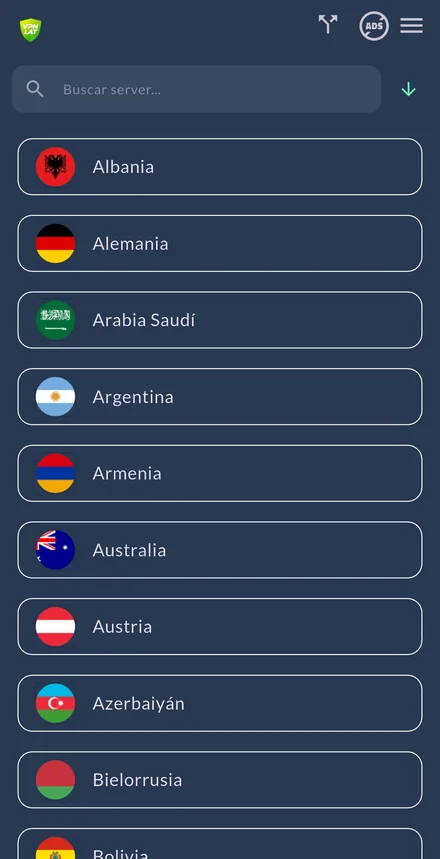
VPN.lat has free servers in Taiwan. No account, no email, no card, no data cap.
Taiwan has some of the best internet infrastructure in Asia and a useful network position: Taipei is a significant interconnection point between Japan, Southeast Asia and North America. If you're in East Asia, it's one of the servers worth measuring.
Get it on Android
Get it on iOS
What a Taiwanese IP is actually for
East Asian routing. If you're in the region, measure it alongside Japan, Hong Kong, South Korea and Singapore. The spread between those five depending on your provider can be tens of milliseconds, and the nearest on the map doesn't always win.
Reaching Taiwanese services from abroad. Residents travelling whose banking, administrative portals or broadcast services block them on detecting a foreign IP.
Regional content. Taiwan has its own audiovisual production and local platforms that restrict outside the country.
Geolocation testing. And a practical note for developers: Taiwan is one of the cases that reveals the most errors in geolocation, language selection and regional catalogue implementations. If your product distinguishes markets in Asia — and particularly if it handles traditional versus simplified Chinese — testing from here is genuinely useful.
An honest warning if you're in Europe or the Americas
If what you want is low ping on Taiwanese servers from the other side of the world, it isn't going to happen.
From Madrid or Mexico City there are more than 10,000 km of cable to Taipei, and that's 200 ms or more round trip as a physical floor. A VPN changes the route, not the distance. You can get the Taiwanese IP — and for many uses that's exactly what's needed — but don't expect low latency. We'd rather tell you before you find out mid-game.
What to know about the jurisdiction
Taiwan has its own data protection legislation and its own regulatory framework. It's a distinct jurisdiction from both the European ones and the others in the region, and it's worth not assuming any external framework applies to it.
What actually matters: what protects you isn't the jurisdiction of the server, it's that the service keeps no records. We keep no activity logs, here and anywhere else we operate. If the records don't exist, it doesn't matter who asks for them or under which law.
What a VPN protects, and what it doesn't
What it does:
Your internet provider stops seeing what you visit. It sees an encrypted connection to a server, and nothing else. Not the sites, not the searches, not the apps.
Websites stop seeing your real IP. They see the server's, shared by many users at once.
Public Wi-Fi stops being a problem. Nobody else on the network can read your traffic.
What it doesn't do:
It doesn't make you anonymous once you log in. Open your email or your social accounts and those services know exactly who you are. The IP changes; your account doesn't.
It doesn't clear cookies or browser fingerprints.
It doesn't protect you from downloading something malicious. It encrypts the road; it doesn't inspect the traffic on it.
It doesn't shorten the distance. Said above.
Public Wi-Fi and travel
Taiwan has very widespread public Wi-Fi: stations, convenience stores, hotels, cafés, transport. It's convenient precisely because it's open.
On any of those networks, anyone else connected is in a position to see a good deal of your traffic, and an open network can be misconfigured or simply fake. If you're about to open your bank or your email on a network that isn't yours, turn the VPN on first.
And if you travel there with a bank in your own country that blocks you for coming from a Taiwanese IP, the server you need is your own country's — check whether it's on the list, and tell your bank before you travel, which works better than any technical trick.
Connect to Taiwan for free
No signup, no email, no seven-day trial, no data cap and no paid tier hiding behind it.
84 countries, all free. If you need a Taiwanese IP, here it is without paying anything; and if you're in East Asia, measure all five regional servers before settling. Compare with our speed test.