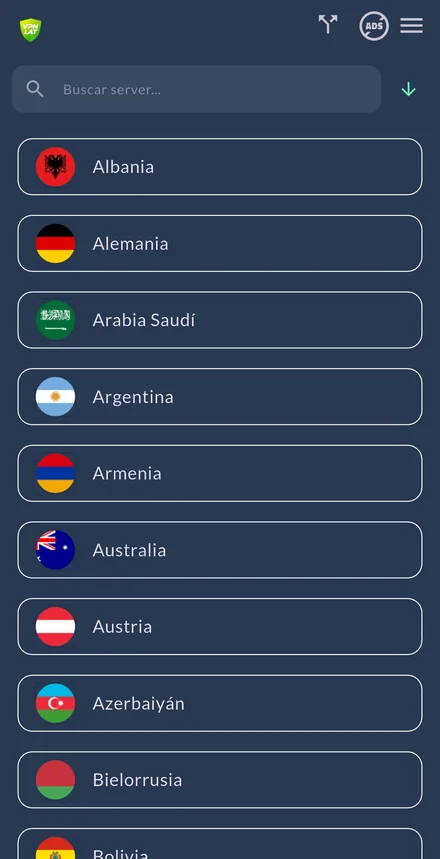
VPN.lat has free servers in Switzerland. No account, no email, no card, no data cap. You download the app, pick Switzerland and you have a Swiss IP.
Switzerland is one of the servers people choose for the jurisdiction rather than for the speed. And as with everything involving Swiss privacy, there's a lot of marketing and not much precision. Let's be precise.
Get it on Android
Get it on iOS
What Swiss jurisdiction actually means
What's true: Switzerland is not part of the Five Eyes, Nine Eyes or Fourteen Eyes intelligence-sharing arrangements. It isn't an EU member either, so its legal framework is its own. It has solid data protection legislation and an institutional tradition of confidentiality that isn't an advertising invention — it's real and it's centuries old.
What's also true, and almost nobody mentions: Switzerland does have data retention obligations for telecommunications providers. It is not a records-free haven. Swiss operators are required to retain certain connection metadata for a period set by law, and legal mechanisms exist to request it. It's a different regime from the EU's, and more protective in several respects, but it is not the absence of a regime.
If what you specifically want is a jurisdiction with no general retention obligation, Seychelles fits that description better than Switzerland. If what you want is a strong, stable legal framework with real judicial oversight, Switzerland is probably the best on this list.
And the most important thing of all: what actually protects you isn't the jurisdiction of the server, it's that the service keeps no records. We keep no activity logs, and that's as true in Switzerland as in any of our other locations. If the records don't exist, it doesn't matter who asks for them or under which law.
That's the honest version. We'd rather give you that than repeat what the rest of the industry says.
What a VPN protects, and what it doesn't
What it does, here and on any of our servers:
Your internet provider stops seeing what you visit. It sees an encrypted connection to a server, and nothing else. Not the sites, not the searches, not the apps.
Websites stop seeing your real IP. They see the server's, shared by many users at once.
Public Wi-Fi stops being a problem. Nobody else on the network can read your traffic.
What it doesn't do:
It doesn't make you anonymous once you log in. Open your email or your social accounts and those services know exactly who you are. The IP changes; your account doesn't.
It doesn't clear cookies or browser fingerprints.
It doesn't protect you from downloading something malicious. It encrypts the road; it doesn't inspect the traffic on it.
It doesn't make you a Swiss tax resident, or change anything else about your legal position. An IP is an IP. Worth stating plainly on a page about a country known for its financial sector: if a bank asks you to verify residence or source of funds, your IP is not what it's evaluating, and using one to appear somewhere you aren't can work against you.
Why you might want a Swiss IP specifically
A preference for the legal framework. Given 84 countries to choose from, some people would rather use one with strong data protection outside the Anglophone intelligence arrangements. That's a reasonable preference, as long as you're clear about what it does and doesn't imply — see above.
Excellent central European routing. This is the underrated reason. Switzerland sits at the geographic and network centre of Europe, with excellent interconnection toward Germany, France and Italy. For gaming or working with European servers, the Swiss server sometimes measures better than the obvious choices. Worth trying.
Access to Swiss services from abroad. Residents travelling whose banking or administrative portals block them for coming from a foreign IP. This is an entirely everyday use and probably the most common one.
Geolocation testing. Switzerland is a multilingual non-EU market in the middle of the EU, which breaks more geolocation, pricing and language implementations than almost any other European locale.
Public Wi-Fi and travel
Switzerland is a country of transit: airports, stations, trains, hotels, conference centres, ski resorts, almost all with open Wi-Fi.
On any of those networks, someone else connected is in a position to see a good deal of your traffic, and an open network can be misconfigured or simply fake. If you're about to open your bank or your email on a network that isn't yours, turn the VPN on first. No caveats.
And if you live in Switzerland and what you're missing is your home country's catalogue, that server is in the app too — check whether it's on the list, because there are 84 but not all of them.
Banking and travel
Swiss online banking is suspicious of foreign logins, and with good reason: it's exactly the pattern of fraud. From abroad you get extra verification, cut sessions or no entry. The same applies to administrative portals.
A Swiss IP makes the session look normal and the task goes through.
Two things worth saying. If you're going to be away a while, tell your bank: the IP isn't the only signal they read — they have your device and your usage pattern too. And for anything requiring a digital identity credential, the VPN replaces nothing.
Connect to Switzerland for free
No signup, no email, no seven-day trial, no data cap and no paid tier hiding behind it.
If what you want is raw speed, the server closest to you will probably win; compare them with our speed test. If what you want is this jurisdiction specifically — with the honest caveats above — here it is, free and with no fine print. 84 countries in the same list.