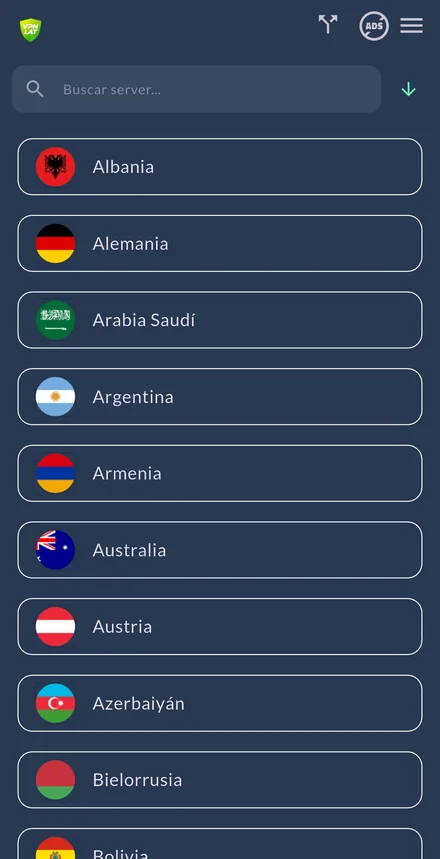
VPN.lat has free servers in Spain. No account, no email, no card, no data cap. You download the app, pick Spain and you have a Spanish IP.
Spain gets an enormous number of visitors and a growing population of remote workers and retirees, so most people reading this in English are either going there, living there, or need a Spanish IP for something specific. This page covers all three.
Get it on Android
Get it on iOS
If you're travelling, working remotely or living in Spain
Your bank at home will get suspicious. A login from Madrid when you normally log in from Manchester or Minneapolis is exactly the pattern of a stolen credential, so banks react: extra verification, cut sessions, or a locked account. Routing through your home country makes the session look normal.
But the thing that works better than any technical trick: tell your bank before you go. The IP isn't the only signal they read — they have your device, your browser and your usage pattern.
Your streaming catalogue will change. Spanish catalogues are licensed separately, so your shows may disappear and your sports package may not include what it did at home. Nothing was taken away; you're looking at the Spanish catalogue. Routing through your home country restores it — and if you're from the EU travelling within the EU, cross-border portability of subscriptions covers exactly this and is on your side.
Public Wi-Fi, which matters more in Spain than most places
Spain lives on tourism, and that means open Wi-Fi in literally everything: hotels, apartments, beach bars, airports, train stations, museums, coworking spaces. It's convenient precisely because it asks nothing of you.
On any of those networks, someone else connected is in a position to see a good deal of your traffic, and an open network can be misconfigured or simply fake — standing up a hotspot named after a hotel is trivial and it's a known pattern in tourist areas.
With the VPN on, everything leaving your device is encrypted from the first hop. If you're about to open your bank, your email or anything with a password, turn it on first. This is the least arguable thing a VPN does and the one most travellers ignore.
Why you might want a Spanish IP specifically
Local services that block foreign connections. Spanish banking, and government portals like the Agencia Tributaria and Seguridad Social, behave differently or fail outright from a foreign IP. If you have Spanish accounts — and plenty of foreign residents do — a Spanish IP is what makes them work.
One caveat worth knowing before you waste time: for anything requiring a digital certificate or Cl@ve, the VPN replaces nothing. You still need the credential installed. It solves the geographic block, not the identification.
Local catalogues and sport. Spanish broadcast services restrict outside the country, and LaLiga feeds included in a Spanish package may not be available abroad. A Spanish IP restores them.
Geolocation testing. Spain is a large market with its own catalogues and pricing, and Spanish-language handling that frequently differs from Latin American variants. If you build anything that distinguishes those, testing from a Spanish IP catches real bugs.
European routing. Madrid and Barcelona are significant exchange points, and a good deal of European and transatlantic traffic passes through. If your destination is in southern Europe or the Americas, measure this one.
Gaming: when a Spanish server helps
In competitive games ping is the only thing about your connection that decides matches, not bandwidth.
Several titles host European servers in Madrid, so for players in Iberia this can be where the game actually is. Where the VPN helps is when your provider is routing you oddly — you have symmetric fibre and 70 ms to a European server that should be 25, because your traffic is going via Paris or Frankfurt first.
What won't happen: if you're in Madrid with a clean route to a Madrid server, adding a VPN adds a hop and ping rises a couple of milliseconds. It isn't an accelerator.
Measure before and after. It's free, so testing costs nothing.
The warning: several competitive games treat region switching as a terms violation, especially where it affects rankings. Playing with friends is one thing; farming an easy region for rank is another, and that one can cost you the account.
Regional store pricing: we're not going to recommend it
Digital stores charge different prices by country, which is why "VPN for cheaper games" never stops being searched.
Let's be straight: we don't recommend it. Steam, PlayStation, Xbox and Nintendo prohibit it explicitly, and the consequences aren't theoretical — rejected purchases, restricted accounts, sometimes a lock with your whole library inside. Most also require a local payment method, so the IP alone rarely suffices.
Where a Spanish IP legitimately helps: your account is Spanish, you're travelling, and the store is showing another country's catalogue or blocking the purchase.
What a VPN doesn't do
It doesn't make you anonymous once you log in. The IP changes; your account doesn't.
It doesn't stop ad tracking by itself. Cookies and browser fingerprinting keep working.
It doesn't replace a digital certificate, as above.
It doesn't protect you from downloading something malicious. It encrypts the road; it doesn't inspect the traffic on it.
And on our side, the part that matters: we keep no activity logs. There's no history of your connections for anyone to request, because we don't create one.
Spain is in the EU, so it applies the European data protection standard, including the obligations that framework places on telecommunications providers. It isn't an exotic privacy jurisdiction and we won't pretend otherwise — what protects you is that we keep no records, not the flag over the data centre.
Connect to Spain for free
No signup, no email, no seven-day trial, no data cap and no paid tier hiding behind it.
84 countries, all free — including whichever one your bank is in, if that's the problem you actually have. Measure a few with our speed test and keep whichever works best.