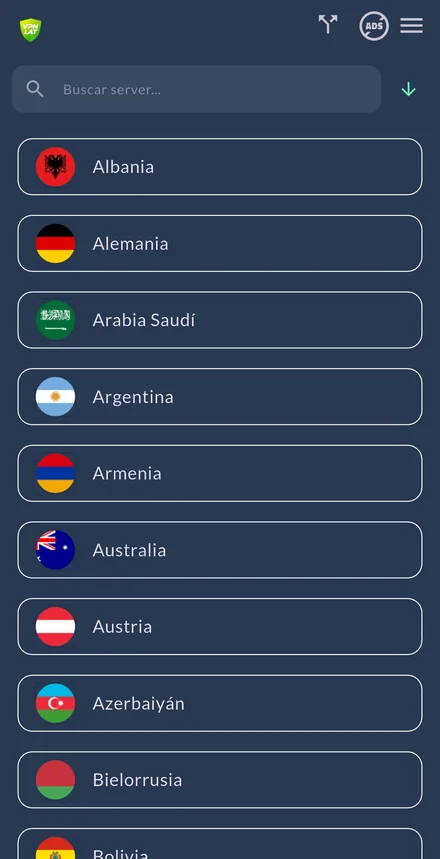
VPN.lat has free servers in North Macedonia. No account, no email, no card, no data cap.
As elsewhere in the Balkans, the main audience for this server is the diaspora: North Macedonia has very large emigration relative to its population, spread across Germany, Switzerland, Italy and Australia, and many of those people keep banking and paperwork in the country.
Get it on Android
Get it on iOS
Banking and paperwork from abroad
This is the main use.
Macedonian online banking is suspicious of logins from abroad — it's exactly the pattern of fraud — so from abroad you get verification that never arrives, cut sessions, or no entry. With a Macedonian IP the session looks normal and the task goes through. The same applies to administrative portals.
And the most useful thing we can tell anyone living abroad: tell your bank. The IP isn't the only signal they read — they also have your device and your usage history, so a VPN may not be enough on its own. Telling them in advance works better than any workaround.
Television and local content. Broadcast services and local platforms restrict outside the country. With a Macedonian IP they work again.
What else a Macedonian IP is for
Balkan routing. If you're in the region, measure it alongside Serbia, Bulgaria, Albania and Greece. In the Balkans the routes depend heavily on your provider and it's worth not assuming anything.
Geolocation testing from a non-EU European country — a case that breaks more implementations than people expect, and North Macedonia in particular trips up services that haven't updated the country's name.
What to know about the jurisdiction
North Macedonia isn't an EU member, so the European data protection framework doesn't apply directly. It has its own legislation, substantially approximated to the European standard through the accession process, but it's its own law and its own authority.
In practice: it's a different jurisdiction, not necessarily a more permissive or a more protective one than an EU one.
And the usual point, which is the true one: what actually protects you isn't the jurisdiction of the server, it's that the service keeps no records. We keep no activity logs, here and anywhere else we operate. If the records don't exist, it doesn't matter who asks for them.
What a VPN protects, and what it doesn't
What it does:
Your internet provider stops seeing what you visit. It sees an encrypted connection to a server, and nothing else.
Websites stop seeing your real IP. They see the server's, shared by many users at once.
Public Wi-Fi stops being a problem. Nobody else on the network can read your traffic.
What it doesn't do:
It doesn't make you anonymous once you log in. The IP changes; your account doesn't.
It doesn't clear cookies or browser fingerprints.
It doesn't protect you from downloading something malicious. It encrypts the road; it doesn't inspect the traffic on it.
It isn't enough on its own with your bank. Said above.
Public Wi-Fi and travel
On the Wi-Fi at a hotel, an airport, a café or a shopping centre, anyone else connected is in a position to see a good deal of your traffic, and an open network can be misconfigured or simply fake.
If you're about to open your bank or your email on a network that isn't yours, turn the VPN on first. This is the least arguable thing a VPN does.
Connect to North Macedonia for free
No signup, no email, no seven-day trial, no data cap and no paid tier hiding behind it. No hidden paid tier and no card to register.
84 countries, all free. If you live abroad and what's blocking you is the bank back home, this is the server that fixes it. Compare speeds with our speed test.