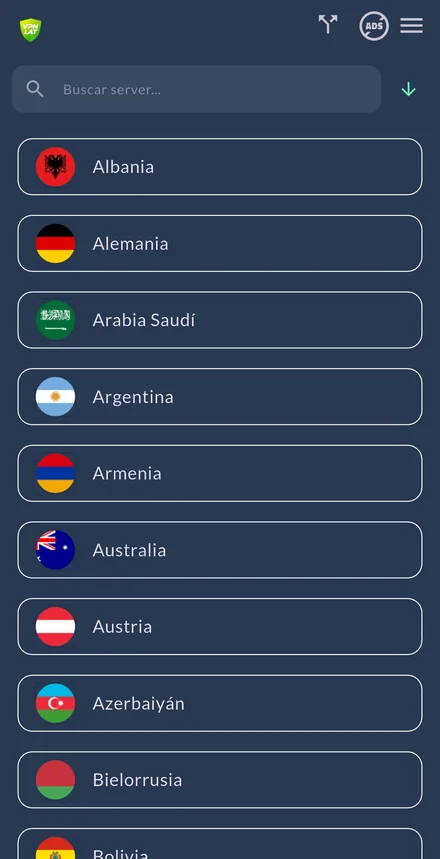
VPN.lat has free servers in the Czech Republic. No account, no email, no card, no data cap.
Prague is one of the significant interconnection points in central Europe, and the Czech Republic has a technical culture and consumer internet infrastructure among the best in the region. For a VPN server that translates into clean routes.
Get it on Android
Get it on iOS
What a Czech IP is actually for
Central European routing. This is the main argument and the one most people ignore. If your destination is in central or eastern Europe and your provider is sending your traffic to Frankfurt, exiting through Prague can genuinely shorten the path. Measure it alongside Germany, Austria and Poland — in this region the gap between measuring and assuming is usually noticeable.
Reaching Czech services from abroad. Residents travelling whose banking, administrative portals or broadcast services block them for coming from a foreign IP.
A quality EU IP for any service that distinguishes inside from outside the European Union.
Geolocation testing from central Europe.
What to know about the jurisdiction
The Czech Republic is an EU member, so it applies the European data protection standard, including the obligations that framework places on telecommunications providers. It isn't an exotic privacy jurisdiction.
What actually matters: what protects you isn't the jurisdiction of the server, it's that the service keeps no records. We keep no activity logs, here and anywhere else we operate. If the records don't exist, it doesn't matter who asks for them.
What a VPN protects, and what it doesn't
What it does:
Your internet provider stops seeing what you visit. It sees an encrypted connection to a server, and nothing else. Not the sites, not the searches, not the apps.
Websites stop seeing your real IP. They see the server's, shared by many users at once.
Public Wi-Fi stops being a problem. Nobody else on the network can read your traffic.
What it doesn't do:
It doesn't make you anonymous once you log in. Open your email or your social accounts and those services know exactly who you are. The IP changes; your account doesn't.
It doesn't clear cookies or browser fingerprints. That's what private mode and clearing site data are for.
It doesn't protect you from downloading something malicious. It encrypts the road; it doesn't inspect the traffic on it.
It doesn't substitute for the digital identity some administrative procedures require.
Public Wi-Fi and travel
Prague is one of the most visited cities in Europe, which means open Wi-Fi in hotels, hostels, cafés, restaurants and transport.
On any of those networks, anyone else connected is in a position to see a good deal of your traffic, and an open network can be misconfigured or simply fake. If you're about to open your bank or your email on a network that isn't yours, turn the VPN on first. This is the least arguable thing a VPN does, and in a city full of tourists it's the one that saves people most often.
And if your bank is in your home country and blocks you for logging in from a Czech IP, the server you need is your own country's — check whether it's on the list.
Connect to the Czech Republic for free
No signup, no email, no seven-day trial, no data cap and no paid tier hiding behind it.
84 countries, all free. And if you're in central Europe, this is one of the servers that wins most often in the region without anyone testing it: because of Prague's position in the network, it deserves a place in your list ahead of the German one. Check it with our speed test.