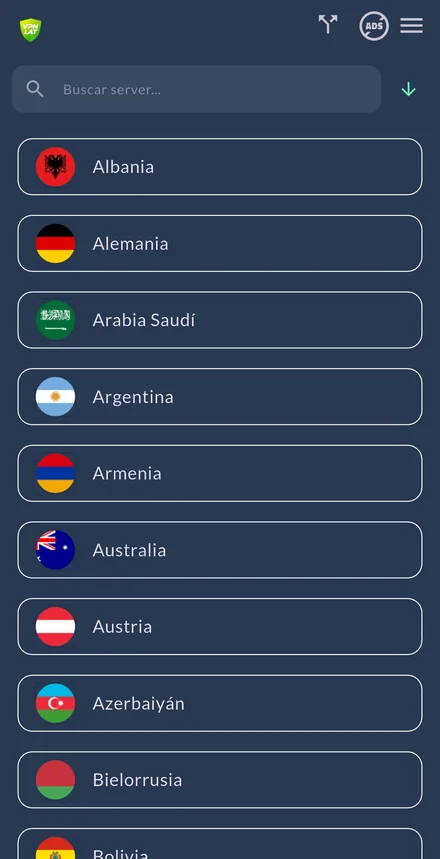
VPN.lat has free servers in South Korea. No account, no email, no card, no data cap. You download the app, pick South Korea and you have a Korean IP.
Like Japan, Korea isn't wanted by a diaspora so much as by people interested in Korea: players who want the Korean server of their game, people following Korean series and music, developers testing from there, and travellers and residents who need to reach things back home.
And there's one expectation that has to be corrected before anything else, because it's the source of almost every disappointment.
Get it on Android
Get it on iOS
The expectation to correct first
South Korea has arguably the best consumer internet infrastructure in the world and a competitive gaming culture with no real equivalent. Several games have their largest and highest-skill server there. That's why people want in.
Here's the problem: if you're in Europe or the Americas, a VPN will not give you playable ping on Korean servers. Mexico City to Seoul is around 12,000 km; Madrid to Seoul around 9,000. That's 200 ms or more round trip as a physical floor, and a VPN changes your route, not the distance.
You can enter the Korean server. What you can't do is play on it properly. At 200 ms in a competitive game you're a liability to your team and an easy target for the other one. We'd rather tell you that than let you discover it in a ranked match.
Where the Korean server genuinely helps: you're in East Asia and your provider is routing badly, or you need a Korean IP for something that isn't latency.
Routing, if you are in Asia
The internet doesn't work by physical distance; it works by peering agreements between networks.
Seoul is a major node with good connectivity to Japan, China, Taiwan and Southeast Asia. If you're in the region, the difference between exiting through Korea, Japan or Singapore can be tens of milliseconds depending on your provider — and the closest on the map doesn't always win.
If you're in South America, the path to Asia almost always goes up through the United States and then crosses the Pacific. That's the real route, and it's why the numbers are high.
Measure South Korea, Japan, Taiwan, Hong Kong and Singapore, and keep whichever wins for you. It's free and there's no signup, so testing costs nothing.
Streaming and regional content: the honest version
This is the most common and most reasonable reason to want a Korean IP.
Streaming catalogues differ by country, and the Korean catalogue includes series, programmes and music that aren't available elsewhere or that premiere there first. With a Korean IP, platforms show you that context, and for someone following Korean content the difference is real and noticeable.
Two honest warnings, and both matter.
Platforms detect and block VPN IP ranges continuously: what works this month may stop next month and nobody can guarantee otherwise.
And plainly: using an IP to reach a catalogue you never subscribed to is against those platforms' terms of service. Watching your own content while travelling is a different thing and is usually covered. The difference is real and the decision is yours, with the facts in front of you.
The Korean thing that surprises everyone: identity verification
This deserves its own section because it stops more people than geographic blocking does.
Many Korean services require local identity verification — a resident registration number, a local phone number, or a domestic payment method — to register or to transact. That applies to game accounts, some stores and plenty of everyday services.
A VPN gives you an IP address. It does not give you an identity. If a Korean service is asking you for that kind of verification, the VPN is not the missing piece and no VPN will be. Knowing this in advance saves you an afternoon.
Where the VPN does work is the other case: the service blocks you before you can even reach it because your IP is foreign. That barrier it removes.
Regional store pricing: we're not going to recommend it
Digital stores charge different prices by country, which is why "VPN for cheaper games" never stops being searched.
Let's be straight: we don't recommend it. Steam, PlayStation, Xbox and Nintendo prohibit it explicitly, and the consequences aren't theoretical — rejected purchases, restricted accounts, sometimes a lock with your whole library inside. With Korean stores the controls are strict and usually demand a local payment method and sometimes local verification, so the IP alone practically never suffices.
And the detail people discover too late: a Korean account and your own country's account are different accounts. What you buy on one is not on the other.
If you're travelling to or living in Korea
Your bank at home will get suspicious. A login from Seoul when you normally log in from London is exactly the pattern of a stolen credential. Routing through your home country makes the session look normal, and that server is in this same app. Tell your bank before you travel — with the time difference, resolving a lockout by phone is painful.
Public Wi-Fi is everywhere — the subway, cafés, shops, hotels — and it's convenient precisely because it's open. On any of those networks, someone else connected is in a position to see a good deal of your traffic, and an open network can be misconfigured or simply fake. Turn the VPN on before you open your bank or your email.
What a VPN doesn't do
It doesn't make you anonymous once you log in. The IP changes; your account doesn't.
It doesn't stop ad tracking by itself. Cookies and browser fingerprinting keep working.
It doesn't shorten the Pacific.
It doesn't replace local identity verification. The most useful line on this page.
It doesn't protect you from downloading something malicious. It encrypts the road; it doesn't inspect the traffic on it.
And on our side, the part that matters: we keep no activity logs. There's no history of your connections for anyone to request, because we don't create one.
Connect to South Korea for free
No signup, no email, no seven-day trial, no data cap and no paid tier hiding behind it.
84 countries, all free. If what you want is low ping on Korean servers from the Americas or Europe, no app on earth will give you that — but if what you want is a Korean IP, here it is without paying anything. Measure with our speed test.