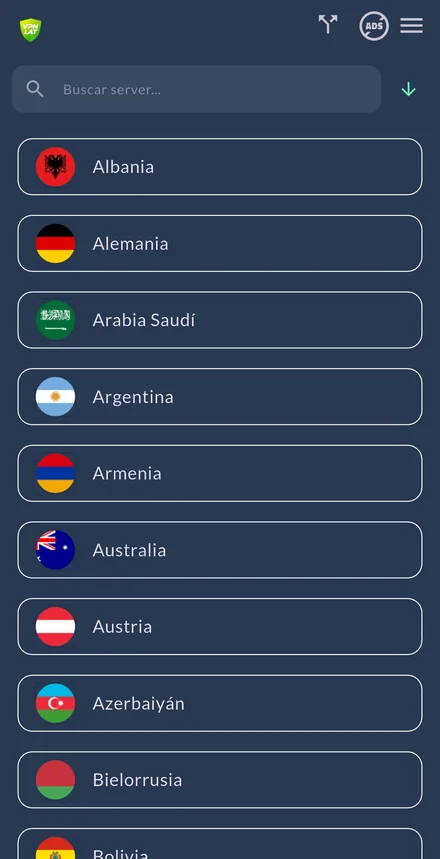
VPN.lat has free servers in Tunisia. No account, no email, no card, no data cap.
The Tunisian server has two uses. If you're outside the country — and there's a significant Tunisian community in France and Italy — it gives you a Tunisian IP to reach your bank and the services that block foreign connections. If you're inside, you want to encrypt your traffic, and Tunisia happens to be well placed: cables linking Africa to Europe run along the Mediterranean coast, so routes to Italy, France and Spain are short.
Get it on Android
Get it on iOS
What gets restricted, and the honest context
Tunisia has had a notable trajectory on this subject: after a historical period of extensive filtering, the picture changed significantly from 2011 onward, and today the country is considerably more open than much of the region.
That said, a more open picture doesn't mean there's nothing to protect. Data retention obligations on operators, traffic visibility on shared networks and the risks of public Wi-Fi exist just as they do in any other country, and those are what this tool addresses.
We don't publish lists of "what's blocked" for any country: they go out of date within weeks and give a false sense of certainty. What's useful is understanding the mechanism, below.
What your provider can see
Without a VPN, your internet provider can see which sites you connect to. The content is encrypted on HTTPS sites — nearly all of them now — but the destination isn't: there's a record that you connected to a given service, at a given time, from a given connection.
With the VPN on, your provider sees one thing: an encrypted connection to a server. Not the sites, not the searches, not the apps.
And if an access restriction were applied at the operator level at any point, the same mechanism bypasses it: your provider stops deciding where you go.
On our side: we keep no activity logs. There's no history of your connections for anyone to request, because we don't create one.
Messaging and calls
Voice and video calls over messaging apps are, on many networks, the first thing to be degraded, because they compete with traditional telephony and are easy to identify in traffic.
If your app calls won't connect or keep dropping while the rest of the app works, it's likely the network rather than your phone. With your traffic inside an encrypted tunnel, the operator sees a connection to a server and can't distinguish a call from any other data.
For families split between Tunisia and Europe, this is the most everyday use of a VPN.
Public Wi-Fi and networks you don't control
Tunisia lives in large part on tourism, which means open Wi-Fi everywhere: hotels, resorts, cafés, airports.
On any of those networks, anyone else connected is in a position to see a good deal of your traffic, and an open network can be misconfigured or simply fake. With the VPN on, what leaves your device is encrypted from the first hop.
If you're about to open your bank, your email or anything with a password from a network that isn't yours, turn it on first. This is the least arguable thing a VPN does, and in a tourist country it's the one that saves people most often.
What a VPN can't promise you
It doesn't make you anonymous. If you log into your email or your social accounts, those services know exactly who you are. The IP changes; your account doesn't.
It isn't immune to detection. Techniques exist to identify and degrade VPN traffic. A server may work today and badly tomorrow; try another from the list.
It doesn't work without a network. If there's no connection, there's nothing to encrypt.
It doesn't protect you from yourself. It doesn't clear cookies, doesn't change your browser fingerprint and doesn't stop you downloading something malicious. It encrypts the road; it doesn't inspect the traffic on it.
It doesn't substitute for knowing the local law. Rules change over time and enforcement varies. If your personal safety depends on this, talk to someone who knows the jurisdiction first-hand.
Streaming and regional content
With a Tunisian IP, platforms treat you as if you were there: you get back the catalogue, the broadcast services and the local sports feeds that block you from abroad.
And the other way round, if you're in Tunisia and want another country's catalogue, there are 83 more servers in the same app. From there, Italy, France and Spain measure best.
Two honest warnings. Platforms detect and block VPN IP ranges continuously: what works this month may stop next month and nobody can guarantee otherwise. And watching your own content while travelling is usually covered by the terms; manufacturing a permanent residence is not.
Banking and paperwork from abroad
For anyone outside the country, this is the strongest reason to use the Tunisian server.
Tunisian online banking is suspicious of foreign logins, and with good reason: it's exactly the pattern of fraud. From France or Italy you get extra verification, cut sessions or no entry at all. The same applies to government portals.
With a Tunisian IP the session looks normal and the task goes through.
Two things worth saying. If you live abroad, tell your bank: the IP isn't the only signal they read — they have your device and your history too. And never log into your bank on public Wi-Fi without the VPN on.
Connect for free
No signup, no email, no seven-day trial, no data cap and no paid tier hiding behind it.
84 countries, all free. If you need a Tunisian IP, here it is without paying anything; and if you're in Tunisia, the country's position on the Mediterranean cables means routes to Europe are usually better than you'd expect. Compare with our speed test.