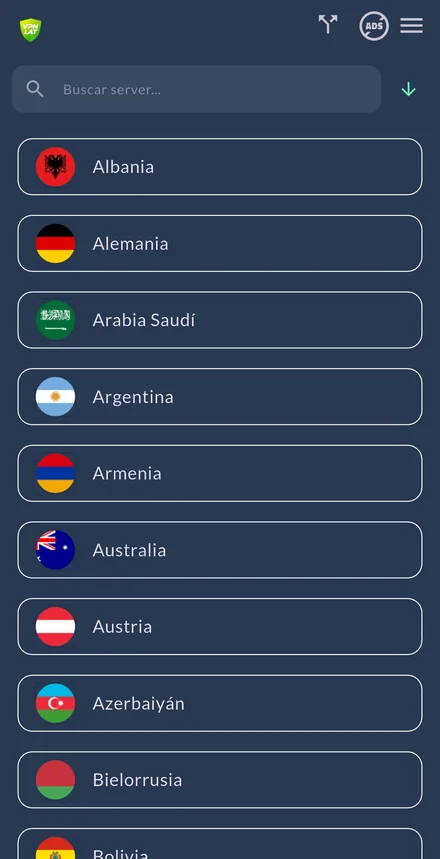
VPN.lat has free servers in Poland. No account, no email, no card, no data cap. You download the app, pick Poland and you have a Polish IP.
Poland has become a serious destination for technology work — large software sector, lower costs than western Europe, and a growing population of foreign professionals. It also has a big, well-connected gaming community. Both of those shape this page.
Get it on Android
Get it on iOS
The routing argument
In competitive games ping is the only thing about your connection that decides matches, not bandwidth. And the internet doesn't work by physical distance; it works by peering agreements between networks.
Poland's position is useful: close enough to Frankfurt and Amsterdam — where European internet infrastructure lives — to have good paths, while covering central and eastern Europe better than the western servers do. Warsaw is an interconnection point with growing weight in the region.
For a player in eastern Europe, the Polish server sometimes measures better than the German one, and that's worth checking because almost nobody checks it. For a player in western Europe, usually not.
Interconnection density in central and eastern Europe is lower than along the Amsterdam–Frankfurt–London axis, so regional traffic frequently goes up to Germany before going anywhere. If your provider and the destination network don't meet in Warsaw, your packet travels to Frankfurt to find where they do.
Try Poland, Germany, the Czech Republic and the Netherlands and keep whichever measures best. In this region the gap between measuring and assuming is usually noticeable. It's free, so testing costs nothing.
What won't happen: a clean route getting faster by adding a hop. It isn't an accelerator.
The warning, because people get caught: several competitive games treat region switching as a terms violation, especially where it affects rankings.
If you're working in or moving to Poland
Your bank at home will get suspicious. A login from Warsaw or Kraków when you normally log in from Dublin is exactly the pattern of a stolen credential, so banks react with extra verification, cut sessions or a lock. Routing through your home country makes the session look normal, and that server is in this same app.
The advice that beats any technical trick: tell your bank, and tell them it's a relocation. The IP isn't the only signal they read — they have your device, your browser and your usage pattern.
Your streaming catalogue will change, because Polish catalogues are licensed separately. If you're from the EU travelling within the EU, cross-border portability of subscriptions covers exactly this and is on your side.
The office network warning, which matters for this audience
Most VPN pages treat corporate filters as a footnote. For the typical English-speaking reader in Poland — working for a software company with international clients — it isn't one.
Encrypted tunnels do get past network filters. But if you work for a company with client security requirements, the acceptable use policy is a real document and breaching it is a real matter. Getting round a filter in that context can be a genuine disciplinary problem, however trivial it is to do technically. We'd rather say that than win a download.
What isn't arguable is using a VPN on open Wi-Fi — the campus, the library, the train, the café. There you're not getting round anything; you're protecting yourself from whoever else is on the network.
Why you might want a Polish IP specifically
Local services that block foreign connections. Polish banking and administrative portals behave differently or fail outright from a foreign IP. If you've opened local accounts — and residents do — a Polish IP is what makes them work from abroad.
One caveat: for anything requiring a digital identity credential, the VPN replaces nothing. You still need the credential. It solves the geographic block, not the identification.
Local catalogues and sport. Polish broadcast and sports services restrict outside the country.
Geolocation testing. Poland is a large market that services frequently handle badly — lumped in with "eastern Europe" when its catalogues, pricing and language handling are all distinct. Testing from here catches real bugs.
Central and eastern European routing, as above.
Public Wi-Fi
Trains, stations, cafés, hotels, airports, shopping centres. On any open network, someone else connected is in a position to see a good deal of your traffic, and an open network can be misconfigured or simply fake.
With the VPN on, everything leaving your device is encrypted from the first hop. If you're about to open your bank, your email or anything with a password, turn it on first. This is the least arguable thing a VPN does.
Regional store pricing: we're not going to recommend it
Digital stores charge different prices by country, and Poland is one of the markets that comes up most often in "VPN for cheaper games" searches.
Let's be straight: we don't recommend it. Steam, PlayStation, Xbox and Nintendo prohibit it explicitly, and the consequences aren't theoretical — rejected purchases, restricted accounts, sometimes a lock with your whole library inside. Most also require a local payment method, so the IP alone rarely suffices.
Where a Polish IP legitimately helps: your account is Polish, you're travelling, and the store is showing another country's catalogue or blocking the purchase.
What a VPN doesn't do
It doesn't make you anonymous once you log in. The IP changes; your account doesn't.
It doesn't stop ad tracking by itself. Cookies and browser fingerprinting keep working.
It doesn't replace a digital identity credential.
It doesn't hide anything from your employer on a work device or a work network.
It doesn't protect you from downloading something malicious. It encrypts the road; it doesn't inspect the traffic on it.
Poland is in the EU, so it applies the European data protection standard, including the obligations that framework places on telecommunications providers. What protects you is that we keep no activity logs — there's no history of your connections for anyone to request, because we don't create one.
Connect to Poland for free
No signup, no email, no seven-day trial, no data cap and no paid tier hiding behind it.
84 countries, all free. And if you're in central or eastern Europe, this is a server worth measuring even though it isn't the obvious one. Check it with our speed test.