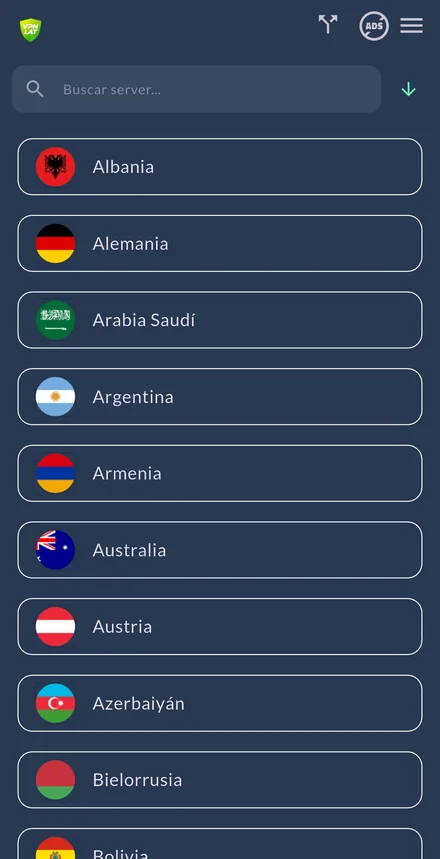
VPN.lat has free servers in New Zealand. No account, no email, no card, no data cap. You download the app, pick New Zealand and you have a NZ IP.
New Zealand is the most remote location on our list, and that honestly shapes what a VPN can do here. Let's deal with that first, then with what it genuinely fixes.
Get it on Android
Get it on iOS
Distance is physics, and that's the headline
The signal travels through fibre at a finite speed. Auckland to the US west coast is over 11,000 km of submarine cable; to Europe, far more. That's 150 ms or more round trip as a physical floor, on the best possible route.
No VPN can lower that, and anyone promising to reduce your trans-Pacific latency is lying to get a download.
What that means in practice: few games host servers in New Zealand. Most Kiwi players connect to Australian servers at 25 to 50 ms depending on route, which is perfectly playable. If your game sends you to Asia or North America, ping is high and will stay high.
Where routing genuinely does help
Having said that, routing matters here more than almost anywhere.
All of New Zealand's international traffic leaves by a small number of submarine cables, usually via Australia or straight across the Pacific. If your provider and the destination network don't meet where you'd want them to, your packet can take an enormous detour — 300 ms or more to destinations that would be half that on the right path.
That case a VPN can fix, and it's the one worth measuring. Try New Zealand, Australia and Singapore if your destination is regional; if your destination is in Europe or the Americas, try routing through the destination country directly.
Measure before and after: ping in-game, connect, ping again. It's free and there's no signup, so testing costs nothing.
Privacy: what this changes and what it doesn't
New Zealand is a member of the Five Eyes intelligence-sharing arrangement, alongside the US, UK, Canada and Australia. That's a matter of public record, and it's a reasonable thing to factor into your choice of server.
With a VPN on, your provider sees one encrypted connection to a server — not the sites, not the searches, not the apps. And on our side: we keep no activity logs. There's no history of your connections for anyone to request, because we don't create one. That last point is the one that actually matters: if the records don't exist, it doesn't matter who asks for them or under which framework.
What it doesn't do:
It doesn't make you anonymous once you log in. The IP changes; your account doesn't.
It doesn't stop ad tracking by itself. Cookies and browser fingerprinting keep working.
It doesn't reduce your data usage. Encryption adds a small but real overhead, so if your problem is a monthly cap, this app isn't the solution.
It doesn't shorten the Pacific.
Matchmaking and region
Most games put New Zealand in the Oceania region with Australia, which has far fewer players than Europe or North America. In niche titles there may be no queue at your hours at all.
Switching to the Asian or North American region gets you matches at the cost of ping. That's a real trade-off and it's yours to make.
The warning is serious though: several competitive games treat region switching as a terms violation, especially where it affects rankings. Finding a game when nobody's online is one thing; farming an easy region for rank is another, and that one can cost you the account.
Streaming, sport and local TV
With a New Zealand IP, platforms treat you as if you were there. That covers the common case: you have NZ subscriptions and you've left the country, or you're abroad and local broadcast and sports services block you for coming from a foreign IP.
Two honest warnings. Platforms detect and block VPN IP ranges continuously: what works this month may stop next month and nobody can promise otherwise. And watching your own content while travelling is usually covered by the terms; using an IP to reach a catalogue you never subscribed to is not.
School, university and office networks
University and office networks filter game ports, Discord and sometimes much more. It isn't personal: someone is managing bandwidth that on a remote island is expensive.
An encrypted tunnel means the filter sees a connection to a server rather than game ports. Technically, it works.
Honestly: if it's your employer's or your university's network, there's an acceptable use policy you almost certainly agreed to, and getting round a filter can be a disciplinary matter. If you're on a student visa, that weighs more than it does for a local.
What isn't arguable is using a VPN on open Wi-Fi — campus, hostel, café.
Public Wi-Fi
On the Wi-Fi at a café, an airport, a hotel or a hostel, someone else connected is in a position to see a good deal of your traffic, and an open network can be misconfigured or simply fake.
With the VPN on, everything leaving your device is encrypted from the first hop. If you're about to open your bank or your email on a network you don't control, turn it on first.
Banking and travel
This is, without competition, the most useful thing on this page for anyone leaving the country.
New Zealand online banking is suspicious of foreign logins — it's exactly the pattern of fraud. From abroad you get verification that never arrives, cut sessions or no entry. The same applies to government portals.
A New Zealand IP makes the session look normal and the task goes through.
And here the time difference makes it serious: when you're awake, your bank's support line is closed, and vice versa. A lockout you'd resolve in Auckland with one phone call can cost you days from Europe. So the advice here is more emphatic than on any other page: tell your bank before you leave. The IP isn't the only signal they read — they have your device, your browser and your usage pattern too. Preventing the block is vastly easier than fixing it.
Connect to New Zealand for free
No signup, no email, no seven-day trial, no data cap and no paid tier hiding behind it.
84 countries, all free. If you're in New Zealand, this server and the Australian one are the only two that are genuinely close to you — measure both with our speed test and keep whichever wins.