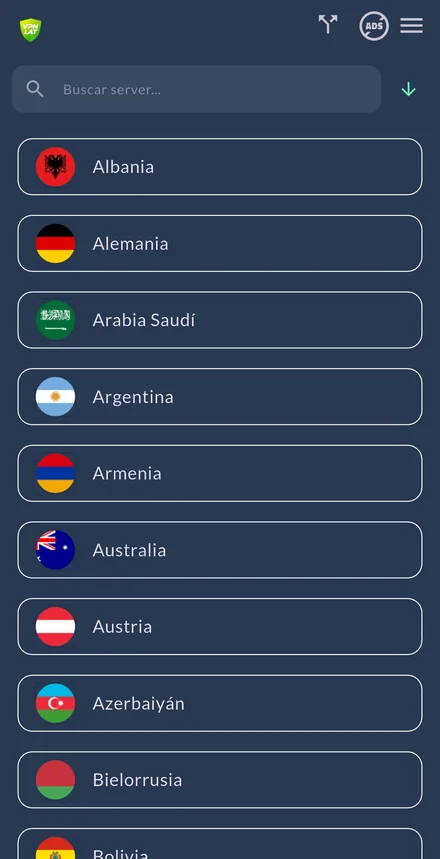
VPN.lat has free servers in Lithuania. No account, no email, no card, no data cap.
Lithuania has a very distinct profile in Europe: it has become a licensing hub for financial technology companies, and a good share of the payments and digital banking apps used across the continent are domiciled there. That means IP-based blocking has very concrete consequences for a lot of people who don't even realise their bank is Lithuanian.
Get it on Android
Get it on iOS
What a Lithuanian IP is actually for
Reaching Lithuanian services from abroad. The most everyday use: residents travelling, or emigrants — Lithuania has substantial emigration to the UK, Ireland, Norway and Germany — whose banking or administrative portals block them for coming from a foreign IP.
Fintech services domiciled there. If you use a European payments app or digital account, there's a real chance the institution is registered in Lithuania. When one of those apps starts demanding odd verification or cutting your session from a particular country, the problem is sometimes geographic rather than account-related.
Baltic routing. Vilnius is well connected toward Poland and Scandinavia. If you're in the region, measure Lithuania alongside Poland, Latvia and Sweden.
Geolocation testing from the Baltic.
What to know about the jurisdiction
Lithuania is an EU member, so it applies the European data protection standard, including the obligations that framework places on telecommunications providers. It isn't an exotic privacy jurisdiction.
What actually matters: what protects you isn't the jurisdiction of the server, it's that the service keeps no records. We keep no activity logs, here and anywhere else we operate.
And a warning that has to be made in a country full of financial institutions: a VPN changes your IP, not your legal situation. If an institution asks you to verify residence or identity, your IP is not what it's evaluating, and using one to fake a location can get your account frozen. With financial services, that isn't theoretical.
What a VPN protects, and what it doesn't
What it does:
Your internet provider stops seeing what you visit. It sees an encrypted connection to a server, and nothing else.
Websites stop seeing your real IP. They see the server's, shared by many users at once.
Public Wi-Fi stops being a problem. Nobody else on the network can read your traffic.
What it doesn't do:
It doesn't make you anonymous once you log in. The IP changes; your account doesn't.
It doesn't clear cookies or browser fingerprints.
It doesn't protect you from downloading something malicious. It encrypts the road; it doesn't inspect the traffic on it.
It doesn't substitute for identity verification. Said above, and in this country it's the most important point.
Public Wi-Fi and travel
On the Wi-Fi at a hotel, an airport, a café or a shopping centre, anyone else connected is in a position to see a good deal of your traffic, and an open network can be misconfigured or simply fake.
If you're about to open your bank or any financial app on a network that isn't yours, turn the VPN on first. On a page about a country of payment institutions, that's worth underlining: money apps are exactly the ones you don't want to use unencrypted on an open network.
Connect to Lithuania for free
No signup, no email, no seven-day trial, no data cap and no paid tier hiding behind it.
84 countries, all free. If you need a Lithuanian IP, here it is without paying anything. Compare with our speed test.