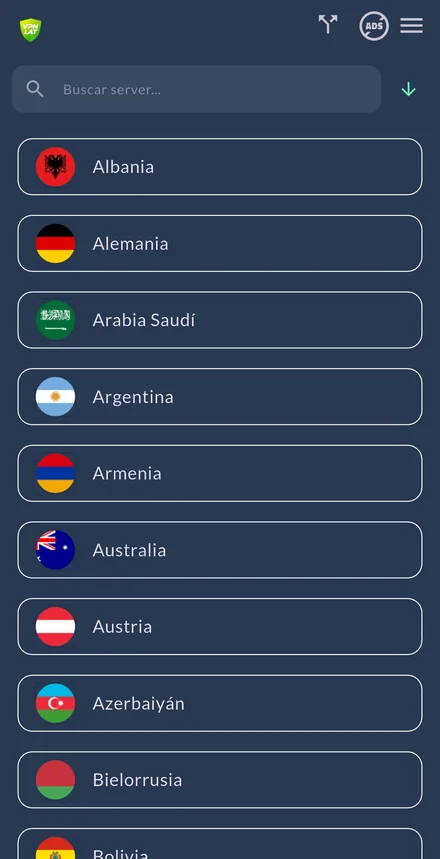
VPN.lat has free servers in Israel. No account, no email, no card, no data cap. You download the app, pick Israel and you have an Israeli IP.
Israel has an unusually large population of dual nationals and people with administrative lives in two countries at once, and that produces one very specific, very repetitive problem that this app actually solves well.
Get it on Android
Get it on iOS
The two-bank problem
If you hold accounts in Israel and somewhere else, you have two banks that block you in opposite directions.
The Israeli bank gets suspicious when you log in from London or New York. The foreign bank gets suspicious when you log in from Tel Aviv. Both are right from their own point of view: logging in from another country is exactly the pattern of a stolen credential.
The practical answer is to keep both servers to hand and switch depending on what you're doing — an Israeli IP for Israeli banking and government portals, your other country's IP for the ones there. Both are free and both are in the same app, so it's two taps.
Two things worth saying. Tell your banks — plural, in this case: the IP isn't the only signal they read, they also have your device and your usage pattern. And for anything requiring a digital identity credential, the VPN replaces nothing; you still need the credential. It solves the geographic block, not the identification.
And never log into either bank on public Wi-Fi without the VPN on.
Why you might want an Israeli IP specifically
Local services that block foreign connections. Israeli banking and administrative portals behave differently or fail outright from a foreign IP. For dual nationals abroad this is the main use.
Local catalogues and broadcast. Israeli broadcast services and local platforms restrict outside the country, so an Israeli IP restores them when you travel.
Geolocation testing. Israel is a substantial technology market with right-to-left text handling, its own catalogues and its own calendar conventions — it breaks more internationalisation implementations than most locales, which makes it genuinely useful for testing.
Eastern Mediterranean routing. Israel is the closest point on our list to the Levant. If your destination is in the region, measure it alongside Cyprus, Greece, Turkey and the UAE.
Routing in the eastern Mediterranean
The internet doesn't work by physical distance; it works by peering agreements between networks.
This matters more here than in central Europe, because traffic leaves the region through a smaller number of cables and regional interconnection is less dense. The practical consequence: two providers in the same country can have very different routes to the same destination.
A VPN changes where your traffic enters and leaves our network. If our path to the destination is better than your provider's, you gain; if not, you lose. For a European destination, measure Israel, Cyprus, Greece and Germany and keep whichever wins — the map misleads, measurement doesn't.
Gaming
In competitive games ping is the only thing about your connection that decides matches, not bandwidth.
Israel's position means ping to European game servers typically lands somewhere between 60 and 100 ms depending on route — playable, but not local. Most European servers are in the centre and north of the continent.
The Israeli VPN server helps when your provider routes badly toward those destinations, and that's worth measuring because routes in this region vary a lot between providers. And if you're outside Israel and want to play with people there, an Israeli IP puts you in their regional context.
The warning, because people get caught: several competitive games treat region switching as a terms violation, especially where it affects rankings.
School, university and office networks
University and office networks filter game ports, Discord and sometimes much more. It isn't personal: someone is managing bandwidth.
An encrypted tunnel means the filter sees a connection to a server rather than game ports. Technically, it works.
Honestly though: if you work at a company with serious security requirements — and Israel has a great many — that acceptable use policy is not decorative, and getting round a filter can be a real disciplinary matter. That's your call, but make it informed.
What isn't arguable is using a VPN on open Wi-Fi — campus, airport, hotel, café.
Regional store pricing: we're not going to recommend it
Digital stores charge different prices by country, which is why "VPN for cheaper games" never stops being searched.
Let's be straight: we don't recommend it. Steam, PlayStation, Xbox and Nintendo prohibit it explicitly, and the consequences aren't theoretical — rejected purchases, restricted accounts, sometimes a lock with your whole library inside. Most also require a local payment method.
Where an Israeli IP legitimately helps: your account is Israeli, you're travelling, and the store is showing another country's catalogue or blocking the purchase.
What a VPN doesn't do
It doesn't make you anonymous once you log in. The IP changes; your account doesn't.
It doesn't stop ad tracking by itself. Cookies and browser fingerprinting keep working.
It doesn't replace a digital identity credential.
It doesn't protect you from downloading something malicious. It encrypts the road; it doesn't inspect the traffic on it.
And on our side, the part that matters: we keep no activity logs. There's no history of your connections for anyone to request, because we don't create one.
Connect to Israel for free
No signup, no email, no seven-day trial, no data cap and no paid tier hiding behind it.
84 countries, all free — and if your life runs across two of them, both are in the same list and switching takes two taps. Measure a few with our speed test.