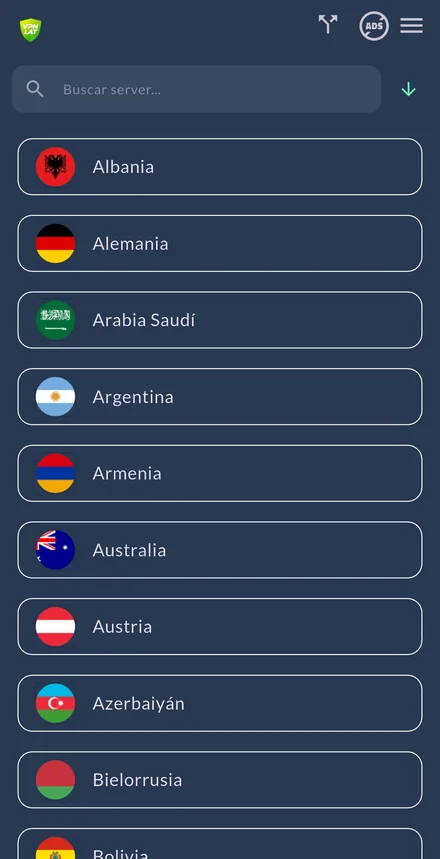
VPN.lat has free servers in the United Kingdom. No account, no email, no card, no data cap. You download the app, pick the UK and you have a British IP.
The UK is one of the most requested servers on our list for a straightforward technical reason: London is one of the biggest internet exchange points on the planet, so the route there tends to be good from almost anywhere. But most people reading this are in Britain, and for them the interesting part is different.
Get it on Android
Get it on iOS
Why your ISP is the reason most people in the UK install a VPN
This is the part worth understanding, and it's specific to Britain.
Under the Investigatory Powers Act, UK internet providers can be required to retain internet connection records — essentially a log of which services each subscriber connected to and when — and a list of public authorities can access them. This is the law as passed, not a rumour. Whatever you think of it as policy, it's the environment your connection lives in.
With a VPN on, your provider sees one thing: an encrypted connection to a server. Not the sites, not the searches, not the apps. There's no itemised list of destinations to retain, because your provider never sees them.
And on our side: we keep no activity logs. There is no history of your connections for anyone to request, because we don't create one.
What it doesn't do, which fewer people will tell you
It doesn't make you anonymous once you log in. Open your email or your social accounts and those services know exactly who you are. The IP changes; your account doesn't.
It doesn't stop ad tracking by itself. Cookies and browser fingerprinting keep working. A VPN hides the route, not your browser.
It doesn't make anything legal that wasn't, and it doesn't protect you from downloading something malicious.
It doesn't hide anything from your employer on a work device or a work network, where IT typically sees far more than your ISP ever did.
BBC iPlayer and the thing nobody admits
This brings a lot of people here, so let's be straight about it.
British public broadcasting restricts its streaming to the UK, and a British IP gets you past the geographic check. That's the technical reality.
What almost nobody says: access to UK public broadcasting is tied to holding a TV Licence, not just to having a British IP address. If you don't hold one, using a UK IP to watch those services isn't a technical question, it's a question of their terms and of UK law. We'll give you the tool and the facts; the decision is yours, and we're not going to pretend the licence doesn't exist to win a download.
The simpler cases are genuinely simple. If you hold a licence and you're travelling, a UK IP restores your access. If you have UK subscriptions and you're abroad, the same applies to your catalogue and your sports feeds.
Two honest warnings: platforms detect and block VPN IP ranges continuously, so what works this month may stop next month and nobody can promise otherwise. And watching your own content while travelling is usually covered by the terms; manufacturing a permanent residence is not.
Gaming: when a UK server actually helps
In competitive games ping is the only thing about your connection that decides matches, not bandwidth.
London hosts European game servers for several titles and is one of the densest interconnection points anywhere, so if you play on European servers and your provider is routing you oddly, routing through London sometimes genuinely shortens the path.
What won't happen: if you're already in the UK with a clean route to a London server, adding a VPN adds a hop and ping rises a couple of milliseconds. It isn't an accelerator.
And if you're outside Europe, don't expect miracles: the Atlantic is about 80 to 100 ms that no app can remove. What you can check is whether your current route to Europe is sane or whether your provider is sending you the long way round. Sometimes that difference is 40 ms.
Measure before and after. It's free, so testing costs nothing.
Throttling, congestion and what a VPN can't fix
Throttling gets blamed for a lot; congestion is the real culprit most of the time. Between 8 and 11pm the local node is full and your ping spikes even though nothing changed in your house.
Telling them apart is easy. If only the game is bad while everything else is fine, and the VPN fixes it, it was routing. If everything is bad at the same time every evening, it's congestion, and a VPN won't fix it — your traffic still crosses the same saturated segment.
Knowing which one you have saves you from upgrading a package that won't change anything.
School, university and office networks
University, college and office networks filter game ports, Discord and sometimes a great deal more. It isn't personal: someone is managing bandwidth.
An encrypted tunnel means the filter sees a connection to a server rather than game ports. It works, technically.
Honestly though: if it's your employer's or your university's network, there's an acceptable use policy you almost certainly agreed to, and getting round a filter can be a disciplinary matter however trivial it is to do. That calculation is yours to make, with that in mind.
What isn't arguable is using a VPN on open Wi-Fi — campus, library, train, café. You're not getting round anything there; you're protecting yourself from whoever else is on the network.
Public Wi-Fi
The UK has open Wi-Fi almost everywhere: trains, Tube stations, high street coffee chains, pubs, hotels, airports. It's convenient precisely because it asks nothing of you.
On any of those networks, someone else connected is in a position to see a good deal of your traffic, and an open network can be misconfigured or simply fake. With the VPN on, everything leaving your device is encrypted from the first hop.
If you're about to open your bank or your email on a network you don't control, turn it on first. No caveats.
Banking and travel
UK online banking is suspicious of foreign logins, and with good reason: it's exactly the pattern of fraud. From abroad you get extra verification, cut sessions or no entry at all. The same applies to HMRC and other government portals, which behave differently or fail from a foreign IP.
A British IP makes the session look normal and the task goes through.
Two things worth saying. If you're going to be away for a while, tell your bank: the IP isn't the only signal they read — they have your device and your usage pattern too. And never log into your bank on public Wi-Fi without the VPN on.
Connect to the UK for free
No signup, no email, no seven-day trial, no data cap and no paid tier hiding behind it.
84 countries, all free. If your destination is anywhere in Europe, London is one of the first servers worth measuring — try it with our speed test and keep whichever works best.