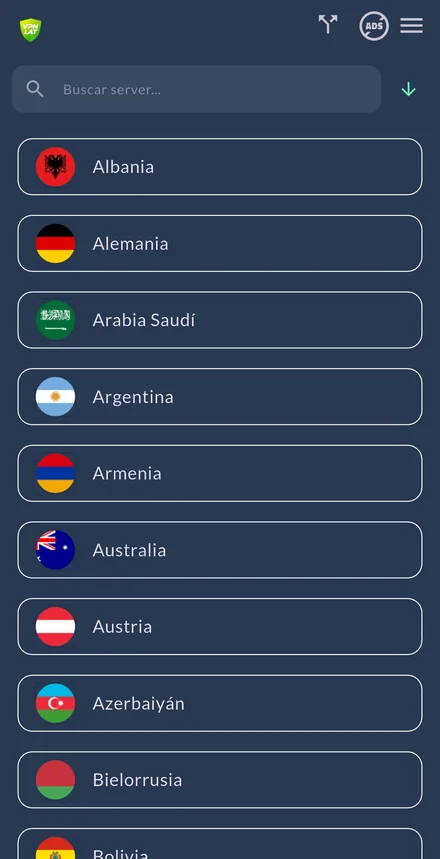
VPN.lat has free servers in Liechtenstein. No account, no email, no card, no data cap.
Liechtenstein is the smallest country on our list: around 40,000 people and 160 square kilometres between Switzerland and Austria. It's worth saying up front what a server there is genuinely for, because it isn't what most people imagine.
Get it on Android
Get it on iOS
What a Liechtenstein IP is actually for
Honestly, this isn't a mass-use server. Its real uses are these:
Geolocation testing. This is probably the main one. If you build or market anything and need to check how it behaves from a European microstate — a case that breaks more implementations than people expect, from address forms to tax logic to shipping calculators — here it is.
Reaching local services from abroad. Residents travelling whose banking or administrative portals block them for coming from a foreign IP. Everyday, even in a small country.
Choosing a jurisdiction. Liechtenstein isn't an EU member, though it is part of the European Economic Area, and it has its own legal framework with a well-known tradition of financial confidentiality. For people who pick a server on that basis, it's a relevant data point.
An Alpine route. It sits between Switzerland and Austria, so if you're in central Europe it's worth measuring alongside those two.
What the jurisdiction actually means
Precision matters here, because this is territory where marketing runs ahead of fact.
Liechtenstein is not in the Five Eyes, Nine Eyes or Fourteen Eyes arrangements, and it isn't an EU member. But it is part of the European Economic Area and applies the European data protection standard, including the obligations that framework places on telecommunications providers. It is not a country without rules.
And what actually matters: what protects you isn't the flag over the data centre, it's that the service keeps no records. We keep no activity logs, and that's as true here as anywhere else we operate. If the records don't exist, it doesn't matter who asks for them.
If you specifically want a jurisdiction with no general retention obligation, Seychelles fits that description better than any European country, including this one.
What a VPN protects, and what it doesn't
What it does:
Your internet provider stops seeing what you visit. It sees an encrypted connection to a server, and nothing else.
Websites stop seeing your real IP. They see the server's.
Public Wi-Fi stops being a problem. Nobody else on the network can read your traffic.
What it doesn't do:
It doesn't make you anonymous once you log in. The IP changes; your account doesn't.
It doesn't clear cookies or browser fingerprints.
It doesn't protect you from downloading something malicious. It encrypts the road; it doesn't inspect the traffic on it.
It doesn't make you a tax resident of Liechtenstein, or change anything else about your legal position. This is worth stating plainly on a page about a country known for its financial sector: a VPN changes your IP and nothing more. If a bank asks you to verify residence or source of funds, your IP is not what it's evaluating, and using one to appear somewhere you aren't can work against you.
Public Wi-Fi and travel
On the Wi-Fi at a hotel, a train, a restaurant or a ski resort, anyone else connected is in a position to see a good deal of your traffic, and an open network can be misconfigured or simply fake.
If you're about to open your bank or your email on a network that isn't yours, turn the VPN on first. This is the least arguable thing a VPN does, and it applies the same in a microstate as in a capital city.
Connect to Liechtenstein for free
No signup, no email, no seven-day trial, no data cap and no paid tier hiding behind it.
If what you want is speed, the Swiss, Austrian or German servers will give you similar or better numbers in central Europe — compare them with our speed test. If what you want is specifically a Liechtenstein IP, for testing or for the jurisdiction, here it is free. 84 countries in the same list.