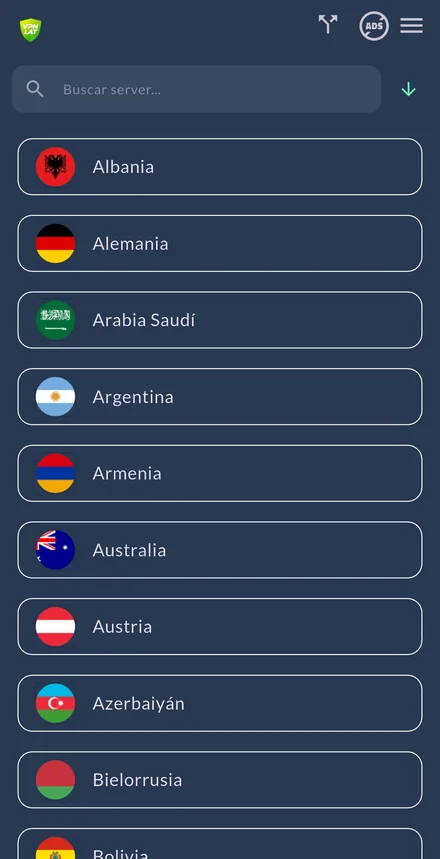
VPN.lat has free servers in Cyprus. No account, no email, no card, no data cap.
Cyprus is an island in the eastern Mediterranean, an EU member, with a foreign population and international business activity that are very large relative to its size. And in network terms it occupies a useful spot: it's the closest European point to the Middle East.
Get it on Android
Get it on iOS
What a Cypriot IP is actually for
Reaching Cypriot services from abroad. The most everyday use: residents travelling whose banking, administrative portals or broadcast services block them on detecting a foreign IP.
A bridge between Europe and the Middle East. If you're in Israel, Lebanon, Egypt or Turkey and need a European IP with a short route, Cyprus is the natural candidate — closer than Greece or Italy. Worth measuring.
An EU IP with a Mediterranean route. As an EU member, a Cypriot IP is a Union IP for the purposes of services that distinguish inside from outside.
Geolocation testing from an unusual location — and Cyprus is genuinely unusual, with a divided island, two official languages and a market services routinely lump in with Greece when they shouldn't.
What to know about the jurisdiction
Cyprus is an EU member, so it applies the European data protection standard, including the obligations that framework places on telecommunications providers. It isn't an exotic privacy jurisdiction, and that's worth saying because its reputation as an international business centre sometimes gets confused with that.
And what actually matters: what protects you isn't the jurisdiction of the server, it's that the service keeps no records. We keep no activity logs, here and anywhere else we operate. If the records don't exist, it doesn't matter who asks for them.
One warning worth making given the country's profile: a VPN changes your IP, not your legal or tax situation. If a bank or a service asks you to verify residence or source of funds, your IP is not what it's evaluating, and using one to appear somewhere you aren't can work against you.
What a VPN protects, and what it doesn't
What it does:
Your internet provider stops seeing what you visit. It sees an encrypted connection to a server, and nothing else.
Websites stop seeing your real IP. They see the server's, shared by many users at once.
Public Wi-Fi stops being a problem. Nobody else on the network can read your traffic.
What it doesn't do:
It doesn't make you anonymous once you log in. The IP changes; your account doesn't.
It doesn't clear cookies or browser fingerprints.
It doesn't protect you from downloading something malicious. It encrypts the road; it doesn't inspect the traffic on it.
It doesn't substitute for identity or residence verification.
Public Wi-Fi and travel
Cyprus is a first-order tourist destination, with open Wi-Fi in hotels, resorts, airports, beaches and cafés. It's convenient precisely because it's open.
On any of those networks, anyone else connected is in a position to see a good deal of your traffic, and an open network can be misconfigured or simply fake. If you're about to open your bank or your email on a network that isn't yours, turn the VPN on first. This is the least arguable thing a VPN does, and on an island full of tourists it's the one that saves people most often.
And if your bank is in your home country and blocks you for logging in from a Cypriot IP, the server you need is your own country's — check whether it's on the list.
Connect to Cyprus for free
No signup, no email, no seven-day trial, no data cap and no paid tier hiding behind it.
84 countries, all free. If you need a Cypriot IP, here it is without paying anything; and if you're in the eastern Mediterranean, this is the closest European server on the whole list to you. Check it with our speed test.