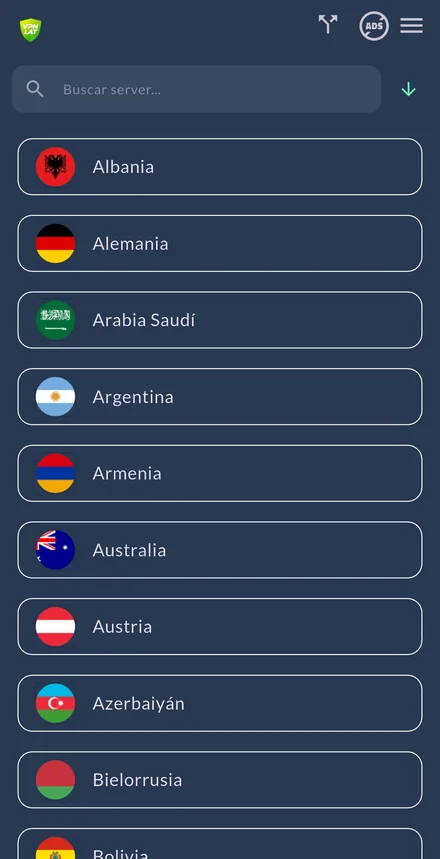
VPN.lat is free and works in Bangladesh. No account, no email, no card, no data cap.
And first of all: we don't have servers inside Bangladesh. We have 84 countries and Bangladesh isn't one of them. If you need a Bangladeshi IP, this isn't the tool, and it's better you know now than after installing the app.
If what you need is to encrypt your connection while in Bangladesh, it works well, and below we'll tell you where to exit.
Get it on Android
Get it on iOS
Which locations work well from Bangladesh
Of our 84 countries, these make sense from there:
Singapore. Normally the best option. It's one of the most important internet nodes in Asia and a good deal of South Asian traffic passes through it. If you only try one, try this.
Thailand. A solid regional alternative, sometimes better than Singapore depending on your provider and the hour.
Hong Kong. A good option when the first two are congested.
Pakistan. Within the subcontinent geographically, though the real route usually takes a detour; worth measuring before dismissing it.
United Arab Emirates. Useful if your traffic is heading toward the Middle East or Europe, and a common route for anyone with family working in the Gulf.
Since it's free and there's no signup, try them all. The difference between the best and worst route from Bangladesh can be over 100 ms, and measuring takes two minutes.
Access restrictions and network shutdowns
This needs to be especially clear, because it's what most people come looking for and it's where a VPN has a hard limit.
Bangladesh has at various points had restrictions on access to platforms and, above all, internet and mobile network shutdowns at regional or national scale, some of them prolonged.
Those two situations are very different and it's worth not confusing them:
If the block is on a specific site or app, it's normally applied at the internet provider: when you request an address, your provider doesn't take you there. A VPN takes your traffic out of that decision and it works.
If the shutdown is of the whole network, a VPN can do nothing. If there's no connection, there's nothing to encrypt. No application on earth solves that, and anyone promising you otherwise is deceiving you to get a download.
We say it this bluntly because in Bangladesh it's a distinction that genuinely matters, not a theoretical nicety.
What your provider can see
Without a VPN, your internet provider can see which sites you connect to. The content is encrypted on HTTPS sites — nearly all of them now — but the destination isn't: there's a record that you connected to a given service, at a given time, from a given connection.
With the VPN on, your provider sees one thing: an encrypted connection to a server outside the country. Not the sites, not the searches, not the apps.
And on our side: we keep no activity logs. There's no history of your connections for anyone to request, because we don't create one.
Messaging and calls
Voice and video calls over messaging apps are usually the first thing to be degraded or restricted on any network, because they compete with traditional telephony and are easy to identify.
If your app calls won't connect or keep dropping while the rest of the app works, it's likely the network rather than your phone. With your traffic inside an encrypted tunnel, the operator sees a connection to a server and can't distinguish a call from any other data.
For the millions of Bangladeshis working abroad who speak to their families by app, this is the main reason to install a VPN, and it's an entirely everyday use.
Public Wi-Fi and networks you don't control
On the Wi-Fi at a café, a university, an airport or a shopping centre, anyone else connected is in a position to see a good deal of your traffic, and an open network can be misconfigured or simply fake.
With the VPN on, what leaves your device is encrypted from the first hop. If you're about to open your bank, your email or anything with a password from a network that isn't yours, turn it on first. No caveats, no fine print.
And something important if your main connection is mobile data, as it is for a great many people there: a VPN does not save you data. Encryption adds a small but real overhead. If your problem is the package running out, this app isn't the solution.
What a VPN can't promise you
It doesn't make you anonymous. If you log into your email or your social accounts, those services know exactly who you are. The IP changes; your account doesn't.
It doesn't give you a Bangladeshi IP, because we have no server there. If you specifically need that — for Bangladeshi banking or local services — this app will not serve you.
It doesn't work without a network. Said above and repeated because it's the most common and most costly misunderstanding.
It doesn't protect you from yourself. It doesn't clear cookies, doesn't change your browser fingerprint and doesn't stop you downloading something malicious.
It doesn't substitute for knowing the local law. Rules on VPN use and on what content is accessible change over time. If your personal safety depends on this, talk to someone who knows your jurisdiction first-hand.
Connect for free
No signup, no email, no seven-day trial, no data cap and no paid tier hiding behind it. On a page read in large part by people working far from home, that deserves saying plainly: no hidden paid tier, no charge in month three, no card to register.
84 countries, all free, and although Bangladesh isn't among them, several work well from there. Start with Singapore, measure with our speed test and keep whichever works best for you.