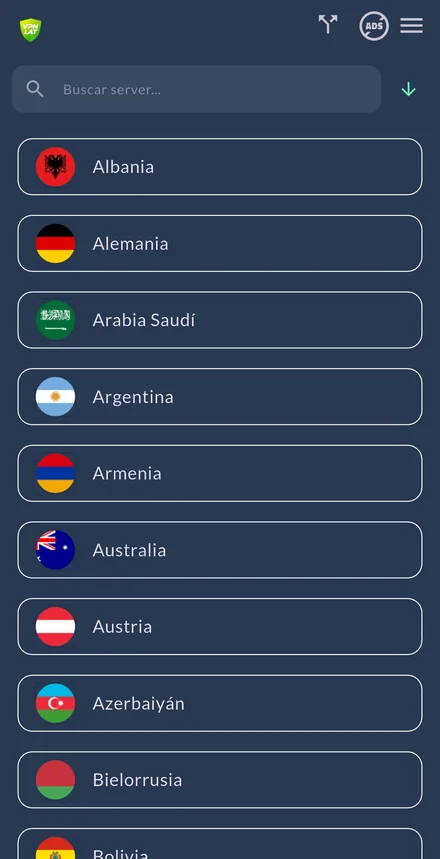
VPN.lat has free servers in Estonia. No account, no email, no card, no data cap.
Estonia is probably the most digitised country in Europe: almost all of its administration runs online, it has an e-residency programme that attracts entrepreneurs worldwide, and a technical culture that makes it a case apart on this list.
That has one very specific consequence for this page, which we'll state without hedging.
Get it on Android
Get it on iOS
What an Estonian IP is actually for
Reaching Estonian services from abroad. The most everyday use, and it weighs more in Estonia than elsewhere precisely because everything is digital: banking, administrative portals, company services. If you're travelling and getting blocked for coming from a foreign IP, an Estonian IP makes the session look normal.
E-residency. There are thousands of people with Estonian companies who don't live there and manage everything online. For them geographic blocking is a recurring nuisance, and this server fixes it.
Baltic routing. Tallinn is well connected to Stockholm and Helsinki. If you're in the Baltic region, measure Estonia alongside Sweden and Finland.
Geolocation testing from a location with first-rate digital infrastructure — and a Finno-Ugric language that breaks naive text handling.
What a VPN can't fix in Estonia, and it matters
This is the most useful thing we can tell you, and it runs against what another site would sell you.
Estonia runs on digital identity for practically everything: the electronic ID card, mobile ID and the associated systems are the front door to public and banking services. A VPN gives you an IP; it does not give you an identity.
So if an Estonian service is asking you for electronic authentication, the VPN is not the missing piece and it won't help you at all. Where it does help is the different case: when the service blocks you before you can authenticate, because your IP is foreign. That barrier it removes.
Knowing which of the two problems you have saves you an afternoon.
What to know about the jurisdiction
Estonia is an EU member, so it applies the European data protection standard, including the obligations that framework places on telecommunications providers. It isn't an exotic privacy jurisdiction.
What it does have is a deeply developed institutional cybersecurity culture, for well-known historical reasons, and that translates into serious infrastructure.
And what actually matters: what protects you isn't the jurisdiction of the server, it's that the service keeps no records. We keep no activity logs, here and anywhere else we operate.
What a VPN protects, and what it doesn't
What it does:
Your internet provider stops seeing what you visit. It sees an encrypted connection to a server, and nothing else.
Websites stop seeing your real IP. They see the server's, shared by many users at once.
Public Wi-Fi stops being a problem. Nobody else on the network can read your traffic.
What it doesn't do:
It doesn't make you anonymous once you log in. The IP changes; your account doesn't.
It doesn't clear cookies or browser fingerprints.
It doesn't protect you from downloading something malicious.
It doesn't substitute for digital identity. Said above, and it's the central point of this page.
Public Wi-Fi and travel
Tallinn has public Wi-Fi everywhere — it's part of the country's digital identity — and it's convenient precisely because it's open.
On any of those networks, anyone else connected is in a position to see a good deal of your traffic, and an open network can be misconfigured or simply fake. If you're about to open your bank or your email on a network that isn't yours, turn the VPN on first. No caveats.
Connect to Estonia for free
No signup, no email, no seven-day trial, no data cap and no paid tier hiding behind it.
84 countries, all free. If you have a company or accounts in Estonia and you're being blocked for being abroad, this is the server that fixes it. And if you're in the Baltic chasing speed, measure it against Sweden and Finland with our speed test.