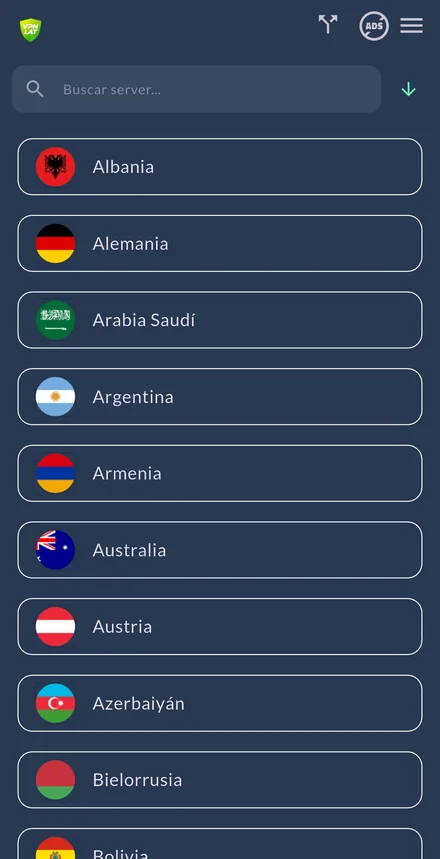
VPN.lat has free servers in Croatia. No account, no email, no card, no data cap.
Croatia has two characteristics that define this page: an Adriatic coast that receives millions of tourists a year, and considerable emigration to Germany, Austria and Ireland. In other words, an enormous number of people connecting from networks they don't control, and an enormous number abroad trying to reach services back home.
Get it on Android
Get it on iOS
Public Wi-Fi: in Croatia this is the main event
We're putting this first because on a coast built for tourism it genuinely is the most useful thing here.
There's open Wi-Fi in absolutely everything: hotels, holiday apartments, campsites, beach bars, marinas, ferries, airports. It's convenient precisely because it's open and asks nothing of you.
On any of those networks, anyone else connected is in a position to see a good deal of your traffic, and an open network can be misconfigured or simply fake — standing up a hotspot named after a beach bar is trivial and it's a known pattern in tourist areas.
If you're on holiday and about to open your bank, your email or anything with a password from the apartment Wi-Fi, turn the VPN on first. It isn't paranoia: it's the exact situation this tool exists for, and it's the only part of all this that isn't up for debate.
And if your bank is in your home country and blocks you for coming from a Croatian IP, the server you need is your own country's — check whether it's on the list.
What a Croatian IP is actually for
Reaching Croatian services from abroad. The most frequent use: Croats travelling or living abroad whose banking, administrative portals or broadcast services block them on detecting a foreign IP. With a Croatian IP the session looks normal and the task goes through.
Adriatic routing. If you're on the coast or in the western Balkans, measure Croatia alongside Slovenia, Italy and Serbia. In that area the route depends heavily on your provider.
An EU IP for any service that distinguishes inside from outside the European Union.
Geolocation testing from the Adriatic.
What to know about the jurisdiction
Croatia is an EU member, so it applies the European data protection standard, including the obligations that framework places on telecommunications providers. It isn't an exotic privacy jurisdiction.
What actually matters: what protects you isn't the jurisdiction of the server, it's that the service keeps no records. We keep no activity logs, here and anywhere else we operate.
What a VPN protects, and what it doesn't
What it does:
Your internet provider stops seeing what you visit. It sees an encrypted connection to a server, and nothing else.
Websites stop seeing your real IP. They see the server's, shared by many users at once.
Public Wi-Fi stops being a problem. Explained above, and it's the main point here.
What it doesn't do:
It doesn't make you anonymous once you log in. The IP changes; your account doesn't.
It doesn't clear cookies or browser fingerprints.
It doesn't protect you from downloading something malicious. It encrypts the road; it doesn't inspect the traffic on it.
It doesn't substitute for the digital identity some procedures require.
Connect to Croatia for free
No signup, no email, no seven-day trial, no data cap and no paid tier hiding behind it.
84 countries, all free. If you need a Croatian IP, here it is without paying anything; and if you're heading to the coast on holiday, install it before you go and use it on every network that isn't yours. Compare speeds with our speed test.