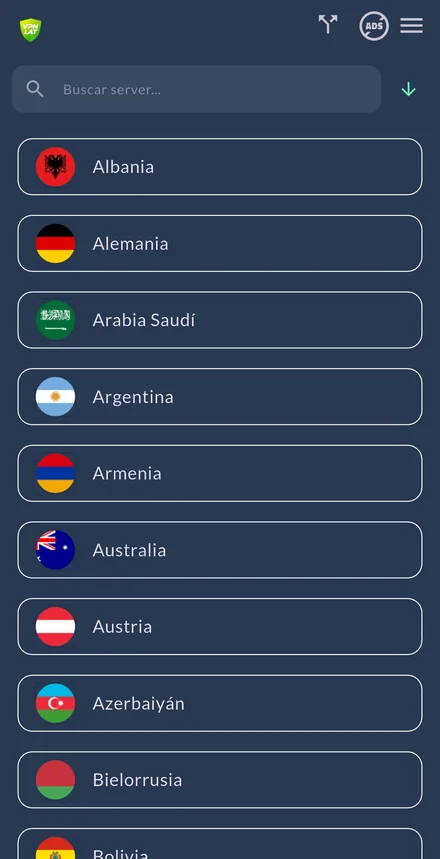
VPN.lat has free servers in Azerbaijan. No account, no email, no card, no data cap.
The Azerbaijani server covers two needs. If you're outside the country, it gives you an Azerbaijani IP for banking and government portals, which block foreign connections. If you're inside, you want to encrypt your traffic. And as a network location, Baku is one of our Caucasus points, useful if you're in the region and your provider is routing badly.
Get it on Android
Get it on iOS
What gets restricted, and how the mechanism works
Azerbaijan has applied restrictions on platforms and services at various points, including limits on social networks during particular events, and there have been episodes of broader traffic restriction.
We're not going to publish a list of "what's blocked": it would be out of date within weeks and would give you a false sense of certainty.
What we can explain is the mechanism. These restrictions are applied at the internet provider: when you request an address, your provider doesn't take you there, or takes you there very slowly. A VPN encrypts your connection and routes it out through a server in another country, so your provider stops deciding where you go.
And the distinction that matters: if a site or platform is blocked, the VPN gets round it. If the whole network is down, there's nothing to encrypt and no application can do anything.
Messaging and calls
Voice and video calls over messaging apps are, on many networks, the first thing to be degraded or restricted, because they compete with traditional telephony and are easy to identify in traffic.
If your app calls won't connect or keep dropping while the rest of the app works, it's likely the network rather than your phone. With your traffic inside an encrypted tunnel, the operator sees a connection to a server and can't distinguish a call from any other data.
Azerbaijan also has a considerable number of people working abroad, and for those families the video call is the main reason a VPN is on the phone at all.
What your provider can see
Without a VPN, your internet provider can see which sites you connect to. The content is encrypted on HTTPS sites — nearly all of them now — but the destination isn't: there's a record that you connected to a given service, at a given time, from a given connection.
With the VPN on, your provider sees one thing: an encrypted connection to a server. Not the sites, not the searches, not the apps.
And on our side: we keep no activity logs. There's no history of your connections for anyone to request, because we don't create one.
Public Wi-Fi and networks you don't control
On the Wi-Fi at a hotel, an airport, a café or a shopping centre, anyone else on the same network is in a position to see a good deal of your traffic, and an open network can be misconfigured or simply fake.
With the VPN on, what leaves your device is encrypted from the first hop. If you're about to open your bank, your email or anything with a password from a network that isn't yours, turn it on first. This is the least arguable thing a VPN does.
What a VPN can't promise you
It doesn't make you anonymous. If you log into your email or your social accounts, those services know exactly who you are. The IP changes; your account doesn't.
It isn't immune to detection. Techniques exist to identify and degrade VPN traffic, and where restrictions are routine they get used. A server may work today and badly tomorrow. If that happens, try another from the list — but nobody promising guaranteed operation is being honest with you.
It doesn't work without a network. If there's no connection, there's nothing to encrypt.
It doesn't protect you from yourself. It doesn't clear cookies, doesn't change your browser fingerprint and doesn't stop you downloading something malicious.
It doesn't substitute for knowing the local law. Rules on VPN use and on what content is accessible change over time, and enforcement varies. If your personal safety depends on this, talk to someone who knows the jurisdiction first-hand. That isn't a formula to shed responsibility — it's that we genuinely cannot know it for you.
Streaming and regional content
With an Azerbaijani IP, platforms treat you as if you were there: you get back the catalogue, the broadcast services and the local feeds that block you from abroad.
And the other way round, if you're in Azerbaijan and want another country's catalogue, there are 83 more servers in the same app. From there, Turkey and the UAE usually measure best.
Two honest warnings. Platforms detect and block VPN IP ranges continuously: what works this month may stop next month and nobody can guarantee otherwise. And watching your own content while travelling is usually covered by the terms; manufacturing a permanent residence is not.
Banking and paperwork from abroad
For anyone outside the country, this is the strongest reason to use the Azerbaijani server.
Azerbaijani online banking is suspicious of foreign logins, and with good reason: it's exactly the pattern of fraud. From abroad you get extra verification, cut sessions or no entry at all. The same applies to government portals, which behave differently or fail when your IP is in another country.
With an Azerbaijani IP the session looks normal and the task goes through.
Two things worth saying. If you're going to be away a while, tell your bank: the IP isn't the only signal they read — they have your device and your usage pattern too. And never log into your bank on public Wi-Fi without the VPN on.
Connect for free
No signup, no email, no seven-day trial, no data cap and no paid tier hiding behind it.
84 countries, all free. If you need an Azerbaijani IP, here it is without paying anything; and if you're in the Caucasus, measure Georgia and Armenia too — they're on the same list. Compare with our speed test.